

See also
A Jupyter notebook version of this tutorial can be downloaded here.
Single shot readout#
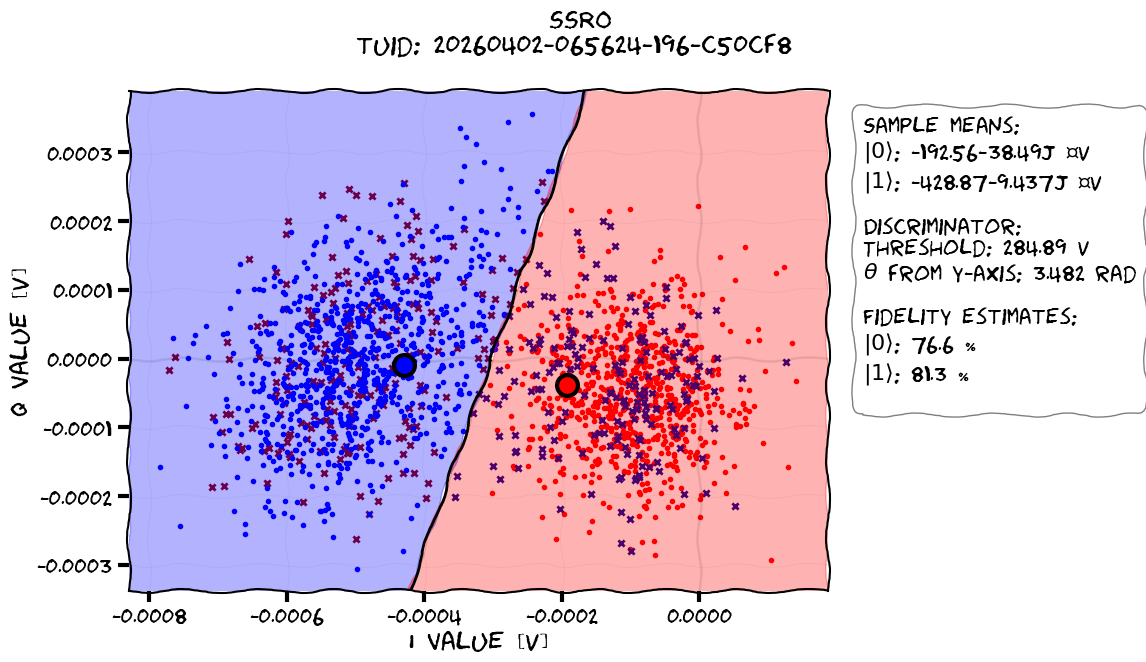
This experiment is performed to calibrate single-shot readout for transmon qubits. The qubit is prepared in either the |0⟩ or |1⟩ state, after which the resonator response is plotted in the IQ plane. From the position of the two centroids a discriminator line is drawn that can be used on the FPGA to classify single shots of the readout resonator into the |0⟩ and |1⟩ qubit states. Furthermore, the structure of the two centroids allows us to quantify how well the two states can be distinguished and to find the State Preparation and Measurement (SPAM) errors. This experiment allows the user to determine the appropriate acquisition rotation and threshold, as described on the page documenting readout.
[1]:
from qblox_applications.qblox_scheduler.analysis import SSROAnalysis
from qblox_applications.qblox_scheduler.superconducting.transmon import (
    BasicTransmonElement,  # noqa: F401
)
from xarray import open_dataset

from qblox_scheduler import DType, HardwareAgent, Measure, Reset, Schedule, X, arange
Setup#
The hardware agent manages the connection to the instrument and ensures that pulses and acquisitions happen over the appropriate input and output channels of the Cluster. The cell below creates an instance of the HardwareAgent based on the hardware- and device-under-test configuration files in the ./dependencies/configs folder, allowing us to start doing measurements. We also define some convenient aliases to use throughout our measurements. For a more thorough discussion of the
hardware- and device-under-test configuration files, check out this tutorial.
[2]:
# Set up hardware agent, this automatically connects to the instrument
hw_agent = HardwareAgent(
    hardware_configuration="./dependencies/configs/hw_config.json",
    quantum_device_configuration="./dependencies/configs/dut_config.json",
)

# convenience aliases
q0 = hw_agent.quantum_device.get_element("q0")  # Qubits 0 and 2 are measured using QRM-RF + QCM-RF
q2 = hw_agent.quantum_device.get_element("q2")
q3 = hw_agent.quantum_device.get_element("q3")  # Qubit 3 is measured using QRC

cluster = hw_agent.get_clusters()["cluster"]
hw_options = hw_agent.hardware_configuration.hardware_options
qubit = q0
/.venv/lib/python3.14/site-packages/qblox_scheduler/qblox/hardware_agent.py:603: UserWarning: cluster: Trying to instantiate cluster with ip 'None'.Creating a dummy cluster.
  warnings.warn(
Experiment settings#
[3]:
num_shots = 1000
Experiment schedule#
[4]:
ssro_sched = Schedule("Readout")

with ssro_sched.loop(arange(start=0, stop=num_shots, step=1, dtype=DType.NUMBER)) as rep:
    ssro_sched.add(Reset(qubit.name))
    # Measure |0>
    ssro_sched.add(Measure(qubit.name, coords={"reps": rep, "state": 0}, acq_label="S_21"))
    # Prepare |1>
    ssro_sched.add(Reset(qubit.name))
    ssro_sched.add(X(qubit=qubit.name))
    # Measure |1>
    ssro_sched.add(Measure(qubit.name, coords={"reps": rep, "state": 1}, acq_label="S_21"))

# Execute the experiment
ssro_data = hw_agent.run(ssro_sched)
if cluster.is_dummy:
    example_data = open_dataset(
        "./dependencies/datasets/single_shot_readout.hdf5", engine="h5netcdf"
    )
    ssro_data.update({"S_21": example_data.S_21})
Analyze the experiment#
[5]:
ssro_analysis = SSROAnalysis(ssro_data).run()
ssro_analysis.display_figs_mpl()
findfont: Failed to find font weight 300 for STIXGeneral, now using 400.
findfont: Failed to find font weight 300 for STIXGeneral, now using 400.
findfont: Failed to find font weight 300 for STIXNonUnicode, now using 400.
findfont: Failed to find font weight 300 for STIXNonUnicode, now using 400.
findfont: Failed to find font weight 300 for STIXSizeOneSym, now using 400.
findfont: Failed to find font weight 300 for STIXSizeTwoSym, now using 400.
findfont: Failed to find font weight 300 for STIXSizeThreeSym, now using 400.
findfont: Failed to find font weight 300 for STIXSizeFourSym, now using 400.
findfont: Failed to find font weight 300 for STIXSizeFiveSym, now using 400.
findfont: Failed to find font weight 300 for cmmi10, now using 400.
findfont: Failed to find font weight 300 for cmsy10, now using 400.
findfont: Failed to find font weight 300 for cmr10, now using 400.
findfont: Failed to find font weight 300 for cmtt10, now using 400.
findfont: Failed to find font weight 300 for cmti10, now using 400.
findfont: Failed to find font weight 300 for cmb10, now using 400.
findfont: Failed to find font weight 300 for cmss10, now using 400.
findfont: Failed to find font weight 300 for cmex10, now using 400.
findfont: Failed to find font weight 300 for DejaVu Sans, now using 400.
findfont: Failed to find font weight 300 for DejaVu Sans, now using 400.
findfont: Failed to find font weight 300 for DejaVu Sans Mono, now using 400.
findfont: Failed to find font weight 300 for DejaVu Sans Display, now using 400.
Post-run#
[6]:
# Update device config
qubit.measure.acq_rotation = ssro_analysis.quantities_of_interest["acq_rotation_rad"].nominal_value
qubit.measure.acq_threshold = ssro_analysis.quantities_of_interest["acq_threshold"].nominal_value
Update the device configuration file#
After measurement, we may store the measured device properties inside a new file to use in future experiments. The time-unique identifier ensures that it is easy to find back previously found measurement results.
[7]:
hw_agent.quantum_device.to_json_file("./dependencies/configs", add_timestamp=True)
[7]:
'./dependencies/configs/two_flux_tunable_transmons_2026-10-15_13-59-10_UTC.json'